GTFS Realtime is the format transit agencies use to publish live data: delays, cancellations, alerts. It is plain Protocol Buffers. This article reads the live feed of all public transport in Switzerland, from opentransportdata.swiss, and turns it into tables of trips and stop delays.
The output below comes from a run on 27 October 2026 at 15:36 CET. The code is not run when the site is built.
What you need
-
An API key. Register at opentransportdata.swiss and subscribe to the GTFS Realtime API in its API Manager. Put the key in
.Renviron, so it stays out of your code: -
protoc, the Protocol Buffers compiler, to turn the schema into a descriptor set. zuproto needs it only for that step. Install it with a package manager:brew install protobuf # macOS apt install protobuf-compiler # Debian, Ubuntu winget install protobuf # WindowsPre-compiled binaries for every system are on protobuf’s releases page.
bufworks instead ofprotoctoo.
The schema
The schema is gtfs-realtime.proto, from Google’s transit repository. zuproto
does not read .proto files. It reads a descriptor
set: the schema already compiled into protobuf’s own binary format.
protoc makes one with --descriptor_set_out.
buf build -o gtfs-realtime.binpb works too.
You only need to do this once. The descriptor set is a small file you can keep next to your code and reuse, and only it is needed from then on.
dir <- tempfile("gtfs-rt-")
dir.create(dir)
proto <- file.path(dir, "gtfs-realtime.proto")
desc <- file.path(dir, "gtfs-realtime.binpb")

download.file(
  paste0(
    "https://raw.githubusercontent.com/google/transit/",
    "474750a163088673df718838d4a1bb093391f9af/",
    "gtfs-realtime/proto/gtfs-realtime.proto"
  ),
  proto,
  quiet = TRUE
)
system2("protoc", c(
  paste0("--proto_path=", dir),
  paste0("--descriptor_set_out=", desc),
  proto
))
desc is now the path to
gtfs-realtime.binpb, a file of about 10 KB.
proto_pool() loads it into a pool, which holds the message
types that zuproto decodes. The GTFS Realtime types join the well-known
types every pool starts with.
pool <- proto_pool(desc)
pool
#> <proto_pool: 12 files, 89 message types>
proto_fields(pool, "transit_realtime.TripUpdate")
#>               name number    type    label
#> 1             trip      1 message required
#> 2          vehicle      3 message optional
#> 3 stop_time_update      2 message repeated
#> 4        timestamp      4  uint64 optional
#> 5            delay      5   int32 optional
#> 6  trip_properties      6 message optional
#>                                    type_name oneof      json_name presence
#> 1            transit_realtime.TripDescriptor  <NA>           trip     TRUE
#> 2         transit_realtime.VehicleDescriptor  <NA>        vehicle     TRUE
#> 3 transit_realtime.TripUpdate.StopTimeUpdate  <NA> stopTimeUpdate    FALSE
#> 4                                       <NA>  <NA>      timestamp     TRUE
#> 5                                       <NA>  <NA>          delay     TRUE
#> 6 transit_realtime.TripUpdate.TripProperties  <NA> tripProperties     TRUE
#>   packed   map extension
#> 1  FALSE FALSE     FALSE
#> 2  FALSE FALSE     FALSE
#> 3  FALSE FALSE     FALSE
#> 4  FALSE FALSE     FALSE
#> 5  FALSE FALSE     FALSE
#> 6  FALSE FALSE     FALSE
The feed
The trip updates feed is one FeedMessage covering the
whole country. The key goes in an Authorization header.
feed <- file.path(dir, "trip-updates.binpb")
download.file(
  "https://api.opentransportdata.swiss/la/gtfs-rt",
  feed,
  mode = "wb",
  quiet = TRUE,
  headers = c(
    Authorization = paste("Bearer", Sys.getenv("OPENTRANSPORTDATA_API_KEY"))
  )
)
file.size(feed)
#> [1] 9402533
One message as a list
proto_decode() turns the message into a named list.
Enums become factors, and fields the feed does not set are left out.
msg <- proto_decode(feed, "transit_realtime.FeedMessage", pool)
str(msg$header)
#> List of 4
#>  $ gtfs_realtime_version: chr "2.0"
#>  $ incrementality       : Factor w/ 2 levels "FULL_DATASET",..: 1
#>  $ timestamp            : num 1.79e+09
#>  $ feed_version         : chr "20261024"
The header’s timestamp is POSIX time, as a
uint64. It is not a well-known Timestamp, so
zuproto leaves it as a number:
.POSIXct(msg$header$timestamp, tz = "Europe/Zurich")
#> [1] "2026-10-27 15:36:18 CET"
feed_version names the GTFS static release that the trip
and stop IDs refer to.
Each element of entity is one trip:
length(msg$entity)
#> [1] 15576
str(msg$entity[[1]])
#> List of 2
#>  $ id         : chr ".ojp-91-71A.1.TA.117.j26|20261027"
#>  $ trip_update:List of 2
#>   ..$ trip            :List of 5
#>   .. ..$ trip_id              : chr ".ojp-91-71A.1.TA.117.j26"
#>   .. ..$ route_id             : chr "91-71A-j26-1"
#>   .. ..$ start_time           : chr "06:57:00"
#>   .. ..$ start_date           : chr "20261027"
#>   .. ..$ schedule_relationship: Factor w/ 8 levels "SCHEDULED","ADDED",..: 1
#>   ..$ stop_time_update:List of 1
#>   .. ..$ :List of 4
#>   .. .. ..$ stop_sequence        : num 1
#>   .. .. ..$ stop_id              : chr "8775605"
#>   .. .. ..$ departure            :List of 1
#>   .. .. .. ..$ delay: int 0
#>   .. .. ..$ schedule_relationship: Factor w/ 4 levels "SCHEDULED","SKIPPED",..: 1
Trips as a data frame
A list of 15,000 trips is awkward to work with.
proto_decode_df() with field = "entity" makes
the repeated entity field the rows of a data frame. Nested
messages become data frame columns, built column by column in C.
system.time(
  entities <- proto_decode_df(
    feed,
    "transit_realtime.FeedMessage",
    pool,
    field = "entity"
  )
)
#>    user  system elapsed
#>   0.662   0.015   0.678
trips <- entities$trip_update
head(trips$trip[c("trip_id", "route_id", "start_time")])
#>                     trip_id     route_id start_time
#> 1  .ojp-91-71A.1.TA.117.j26 91-71A-j26-1   06:57:00
#> 2  .ojp-91-71A.1.TA.136.j26 91-71A-j26-1   06:57:00
#> 3 .ojp-92-9-L.1.TA.1895.j26 92-9-L-j26-1   08:41:00
#> 4 .ojp-92-9-L.1.TA.5119.j26 92-9-L-j26-1   09:45:00
#> 5 .ojp-91-1-D.1.TA.2450.j26 91-1-D-j26-1   11:07:00
#> 6  .ojp-91-71B.1.TA.143.j26 91-71B-j26-1   11:15:00
schedule_relationship is a factor, so counting cancelled
and added trips is a table():
table(trips$trip$schedule_relationship)
#>
#>   SCHEDULED       ADDED UNSCHEDULED    CANCELED REPLACEMENT  DUPLICATED
#>       15187         245           0         144           0           0
#>     DELETED         NEW
#>           0           0
Delays at each stop
stop_time_update is a repeated message, so each row
holds a data frame of that trip’s stops. Swiss stop IDs are mostly
SLOIDs (ch:1:sloid:…), with some older numeric IDs.
str(trips$stop_time_update[[3]])
#> 'data.frame':    30 obs. of  7 variables:
#>  $ stop_sequence             : num  1 2 3 4 5 6 7 8 9 11 ...
#>  $ stop_id                   : chr  "ch:1:sloid:9321:0:714096" "ch:1:sloid:9319:0:585873" "ch:1:sloid:9315:0:466337" "ch:1:sloid:92711:0:37662" ...
#>  $ arrival                   :'data.frame':  30 obs. of  4 variables:
#>   ..$ delay         : int  NA 21882 21888 21864 21912 21864 21894 21870 21846 21840 ...
#>   ..$ time          : num  NA NA NA NA NA NA NA NA NA NA ...
#>   ..$ uncertainty   : int  NA NA NA NA NA NA NA NA NA NA ...
#>   ..$ scheduled_time: num  NA NA NA NA NA NA NA NA NA NA ...
#>  $ departure                 :'data.frame':  30 obs. of  4 variables:
#>   ..$ delay         : int  21900 21882 21888 21864 21912 21864 21894 21870 21846 21840 ...
#>   ..$ time          : num  NA NA NA NA NA NA NA NA NA NA ...
#>   ..$ uncertainty   : int  NA NA NA NA NA NA NA NA NA NA ...
#>   ..$ scheduled_time: num  NA NA NA NA NA NA NA NA NA NA ...
#>  $ departure_occupancy_status: Factor w/ 9 levels "EMPTY","MANY_SEATS_AVAILABLE",..: NA NA NA NA NA NA NA NA NA NA ...
#>  $ schedule_relationship     : Factor w/ 4 levels "SCHEDULED","SKIPPED",..: 1 1 1 1 1 1 1 1 1 1 ...
#>  $ stop_time_properties      : logi  NA NA NA NA NA NA ...
A message field that no stop of a trip sets, such as
arrival at a first stop, is an all-NA column
rather than a data frame. A small helper covers both cases when pulling
out the delays:
delay <- function(stops, event) {
  x <- stops[[event]]
  if (is.data.frame(x)) x$delay else rep(NA_integer_, nrow(stops))
}

updates <- trips$stop_time_update
n <- vapply(updates, nrow, integer(1))
stops <- data.frame(
  trip_id = rep(trips$trip$trip_id, n),
  stop_id = unlist(lapply(updates, `[[`, "stop_id")),
  arrival_delay = unlist(lapply(updates, delay, "arrival")),
  departure_delay = unlist(lapply(updates, delay, "departure"))
)
nrow(stops)
#> [1] 190161
head(stops)
#>                     trip_id                  stop_id arrival_delay
#> 1  .ojp-91-71A.1.TA.117.j26                  8775605            NA
#> 2  .ojp-91-71A.1.TA.136.j26                  8775605            NA
#> 3 .ojp-92-9-L.1.TA.1895.j26 ch:1:sloid:9321:0:714096            NA
#> 4 .ojp-92-9-L.1.TA.1895.j26 ch:1:sloid:9319:0:585873         21882
#> 5 .ojp-92-9-L.1.TA.1895.j26 ch:1:sloid:9315:0:466337         21888
#> 6 .ojp-92-9-L.1.TA.1895.j26 ch:1:sloid:92711:0:37662         21864
#>   departure_delay
#> 1               0
#> 2               0
#> 3           21900
#> 4           21882
#> 5           21888
#> 6           21864
Delays are in seconds. Most departures are within a minute or two of schedule:
minutes <- stops$departure_delay / 60
minutes <- minutes[!is.na(minutes) & minutes >= -2 & minutes <= 10]
hist(
  minutes,
  breaks = seq(-2, 10, by = 0.25),
  main = "Departure delays across Switzerland",
  xlab = "Minutes late",
  col = "grey70",
  border = "white"
)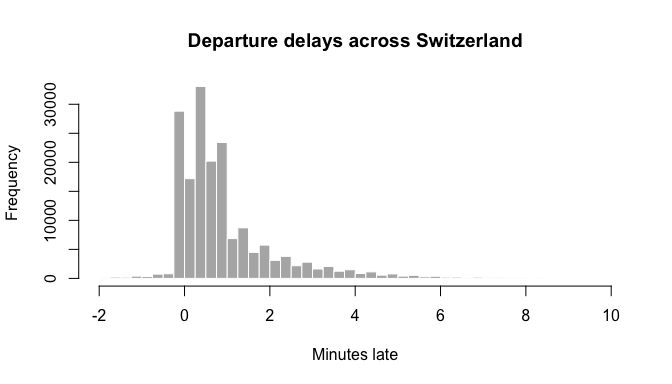
plot of chunk delays
As JSON
proto_to_json() writes protobuf’s canonical JSON. Here
is one trip, encoded back to binary from its list form first:
one <- proto_encode(msg$entity[[2]], "transit_realtime.FeedEntity", pool)
cat(proto_to_json(one, "transit_realtime.FeedEntity", pool))
#> {"id":".ojp-91-71A.1.TA.136.j26|20261027","tripUpdate":{"trip":{"tripId":".ojp-91-71A.1.TA.136.j26","startTime":"06:57:00","startDate":"20261027","scheduleRelationship":"SCHEDULED","routeId":"91-71A-j26-1"},"stopTimeUpdate":[{"stopSequence":1,"departure":{"delay":0},"stopId":"8775605","scheduleRelationship":"SCHEDULED"}]}}
The same mapping for the whole feed is about three times the size of the binary:
nchar(proto_to_json(feed, "transit_realtime.FeedMessage", pool)) /
  file.size(feed)
#> [1] 3.063439
Notes
- The limit is two requests a minute per key. The feed is refreshed every 30 seconds, so polling faster gains nothing.
- Service alerts are a separate feed with a separate subscription.
They use the same schema: decode them as
transit_realtime.FeedMessagetoo. - transport.opendata.ch serves the same timetable data as JSON, if you would rather not handle protobuf.