A stash is meant to be shared: by interactive sessions, scheduled jobs and parallel workers on one machine, all at once. This article covers what that asks of you, and what dastash guarantees in return.
Where a stash can live
On a local filesystem of the machine whose processes use it. The engine underneath, ‘libmdbx’, memory-maps the database and coordinates writers through a lock file, and both need a local filesystem. A stash on a network filesystem (NFS, SMB, a cloud file share) is not supported.
Many processes
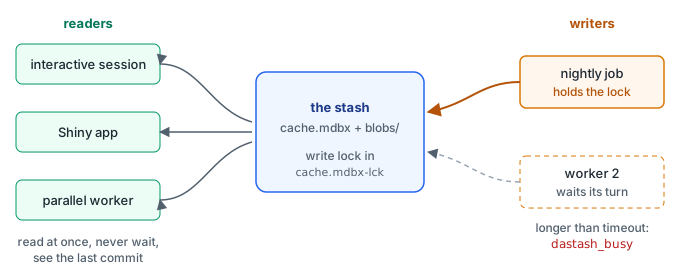
Any number of processes can read at once, and never wait: a read sees
the last committed state. Writes take turns. A write that waits longer
than timeout seconds (60 by default) for another process’s
write raises dastash_busy, not a hang.
Each process opens the stash itself. A handle cannot be carried into
a forked child, such as a parallel::mclapply() worker.
Using it there raises dastash_forked, so open the stash
inside the worker:
parallel::mclapply(keys, function(k) {
  s <- stash(dir)
  on.exit(stash_close(s))
  stash_get(s, k, default = NULL)
})
Workers started as fresh processes (‘callr’, ‘mirai’, ‘future’ with multisession) have nothing to inherit, and open the stash like any other process.
Every single operation is atomic across processes. Eight processes
calling stash_incr() on one key count eight.
stash_add() writes only if there is no entry.
stash_pop() reads and deletes in one step.
stash_incr(s, "jobs-run")
#> [1] 1
stash_add(s, "lock/nightly", Sys.getpid(), expire = 3600)
#> [1] TRUE
stash_add(s, "lock/nightly", Sys.getpid())
#> [1] FALSE
Transactions
stash_transact() makes a block of writes atomic: all
commit, or none do.
stash_set(s, "balance", 100)
stash_transact(s, {
  stash_set(s, "balance", stash_get(s, "balance") - 30)
  stash_incr(s, "withdrawals")
})
#> [1] 1
stash_get(s, "balance")
#> [1] 70
It holds the write lock while it runs, so other processes’ writes wait for it. Keep it short, and never compute something slow inside it. It is also the fastest way to write many entries: making a write durable is the expensive part, and a transaction pays it once.
Memoised functions follow the same rule. Two processes that miss the same call at the same moment both compute it, and one result is kept. That is duplicated work, never a wrong answer.
Durability
By default (durability = "safe") every write is on disk
before it returns. durability = "fast" skips waiting for
the disk: a crash of the machine can lose recent writes, but never
damages the stash. "unsafe" can damage it, for stashes you
can rebuild. The first process to open a stash sets this for every
process that opens it while it is open; stash_stats()
reports what is in force.
stash_stats(s)$durability
#> [1] "safe"
Staying within a size limit
size_limit bounds what the entries hold. A write that
goes over it evicts the least recently stored entries, a few at a time,
so the limit holds without a background process.
stash_cull() finishes the job at once. Expired entries go
first.
for (i in 1:5) stash_set(s, paste0("frame/", i), runif(5e4))
stash_count(s)
#> [1] 2
stash_cull(s)
stash_count(s)
#> [1] 2
The database file keeps the pages it frees for reuse rather than
shrinking, so stash_volume(), which reports bytes on disk,
can stay above the limit.
Checking and repairing
A process that dies in the middle of a write can leave, at most, a
file that nothing refers to. On Linux and Windows the write lock it held
is released at once. On macOS it is not, a limitation of the storage
engine there: reads carry on, but every write raises
dastash_busy until every process with the stash open has
closed it; the next process to open it then recovers the lock.
stash_check() finds that, and any other damage.
repair = TRUE fixes it, and hash = TRUE also
verifies every stored file’s content.
stash_check(s)
#> [1] kind     key      path     detail   repaired
#> <0 rows> (or 0-length row.names)
stash_check(s, repair = TRUE)
#> [1] kind     key      path     detail   repaired
#> <0 rows> (or 0-length row.names)
Run it now and then from a maintenance job, as you would
stash_cull().
stash_close(s)
unlink(dir, recursive = TRUE)