dastash keeps R values on disk, under keys, for as long as you want them and no longer. A stash is a directory: open it, read and write it, and every R process on the machine that opens the same directory sees the same entries.
library(dastash)

dir <- file.path(tempdir(), "getting-started")
s <- stash(dir)
s
#> <dastash_stash> /tmp/RtmpeZh0aR/getting-started
#>   entries 0 · eviction least-recently-stored · durability safe
Reading and writing
stash_set() stores a value under a key and returns the
stash, so writes chain. stash_get() reads it back.
s |>
  stash_set("greeting", "hello") |>
  stash_set("numbers", 1:10)

stash_get(s, "numbers")
#>  [1]  1  2  3  4  5  6  7  8  9 10
A key with no entry is an error, unless you supply a
default. A stored NULL is a value like any
other, so the two never get confused.
try(stash_get(s, "absent"))
#> Error in stash_get(s, "absent") : No entry for key "absent".
#> ℹ Supply `default` to return a value instead of erroring.
stash_get(s, "absent", default = NA)
#> [1] NA
stash_has(s, c("greeting", "absent"))
#> [1]  TRUE FALSE
stash_mget() and stash_mset() read and
write several entries at once, and stash_delete() removes
entries.
stash_mset(s, list(a = 1, b = 2))
stash_mget(s, c("a", "b"))
#> $a
#> [1] 1
#>
#> $b
#> [1] 2
stash_delete(s, c("a", "b"))
Keys
A string is its own key, so a "group/item" convention
gives you prefixes to list by:
stash_set(s, "prices/XSWX", 101.2)
stash_set(s, "prices/XNYS", 57.8)
stash_keys(s, prefix = "prices/")
#> [1] "prices/XNYS" "prices/XSWX"
A key can also be a number, a date, a vector or a named list. It is
written in a fixed text encoding: names are sorted, 1L and
1 agree, and a time zone is not part of a time’s identity,
so the same values always find the same entry.
Expiry and tags
An entry can expire: after a number of seconds, a
difftime, or at a POSIXct time. An expired
entry is gone for every reader at once.
stash_set(s, "session-token", "abc123", expire = as.difftime(30, units = "mins"))
stash_set(s, "stale", 1, expire = 0)
stash_has(s, "stale")
#> [1] FALSE
Tags group entries for invalidation. Tag everything derived from one source, and drop it all when that source changes:
stash_set(s, "report/q3", "...", tags = "ledger")
stash_set(s, "report/q4", "...", tags = "ledger")
stash_evict(s, tag = "ledger")
stash_keys(s, prefix = "report/")
#> character(0)
Memoising a function
stash_memoise() wraps a function so that each call is
looked up first and computed only on a miss. The results outlive the
session, and every process using the stash shares them.
slow_mean <- function(n, seed = 1) {
  Sys.sleep(0.5)
  set.seed(seed)
  mean(rnorm(n))
}
fast_mean <- stash_memoise(slow_mean, s)

system.time(fast_mean(1e5))
#>    user  system elapsed
#>   0.006   0.000   0.507
system.time(fast_mean(1e5))
#>    user  system elapsed
#>   0.000   0.000   0.001
A call is keyed on the function’s name and its arguments, with
defaults filled in, so fast_mean(1e5) and
fast_mean(1e5, seed = 1) are the same entry. The key does
not depend on the function’s code: when its meaning changes, pass a new
version.
stash_memoise_key(fast_mean, 1e5)
#> [1] "slow_mean/v1/{n=i:100000,seed=i:1}"
stash_forget(fast_mean, 1e5)
Large values
Values of inline_max bytes (32 KiB) or more are stored
as read-only files, named by the hash of their content, so identical
values are stored once. stash_path() gives the file, for
tools that read it in place.
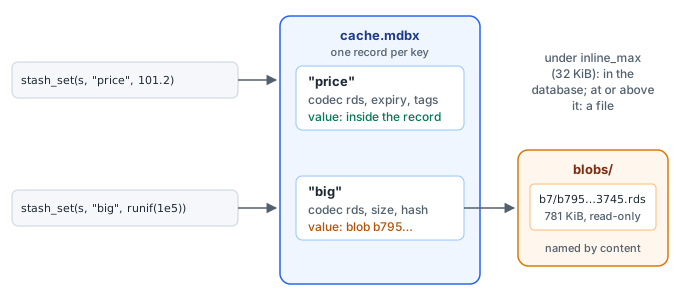
cache.mdbx; a large one becomes a file in
blobs/ that the record points at.The stash’s directory holds the database, its lock file, the files and a staging area:
getting-started/
├── cache.mdbx        every record and index
├── cache.mdbx-lck    the lock that coordinates processes
├── blobs/b7/b795…3745.rds
└── tmp/ files being written, before they are publishedLooking inside
stash_entries(s)[, c("key", "bytes", "inline", "expires")]
#>                                   key  bytes inline             expires
#> 1                                 big 800031  FALSE                <NA>
#> 2                            greeting      5   TRUE                <NA>
#> 3                             numbers    133   TRUE                <NA>
#> 4                         prices/XNYS     39   TRUE                <NA>
#> 5                         prices/XSWX     39   TRUE                <NA>
#> 6                       session-token      6   TRUE 2026-10-31 13:55:34
#> 7 {date=d:2026-08-29,exchange=s:XSWX}      6   TRUE                <NA>
stash_stats(s)[, c("count", "bytes_inline", "bytes_blob", "volume")]
#>   count bytes_inline bytes_blob  volume
#> 1     8          267     800031 1062175
stash_close(s)
unlink(dir, recursive = TRUE)